When we say “trendy,” we usually think of the latest fashion in clothing or interior design. But in garden design, trends evolve more slowly and conservatively. Traditional lawns and flower beds along fences and walkways dominate most plots and are slow to change. It’s not easy to step away from familiar styles and allow yourself even a small wildflower patch, to stop mowing the lawn and let nature breathe a little. Just a handful of wildflower seeds can create a living corner in your garden that attracts butterflies, bees, birds, and other creatures.
This natural garden style is what’s trending now – the move toward ecological, meadow-inspired spaces is gaining popularity. I understand it’s a big shift for many, but I suggest at least to start considering it.
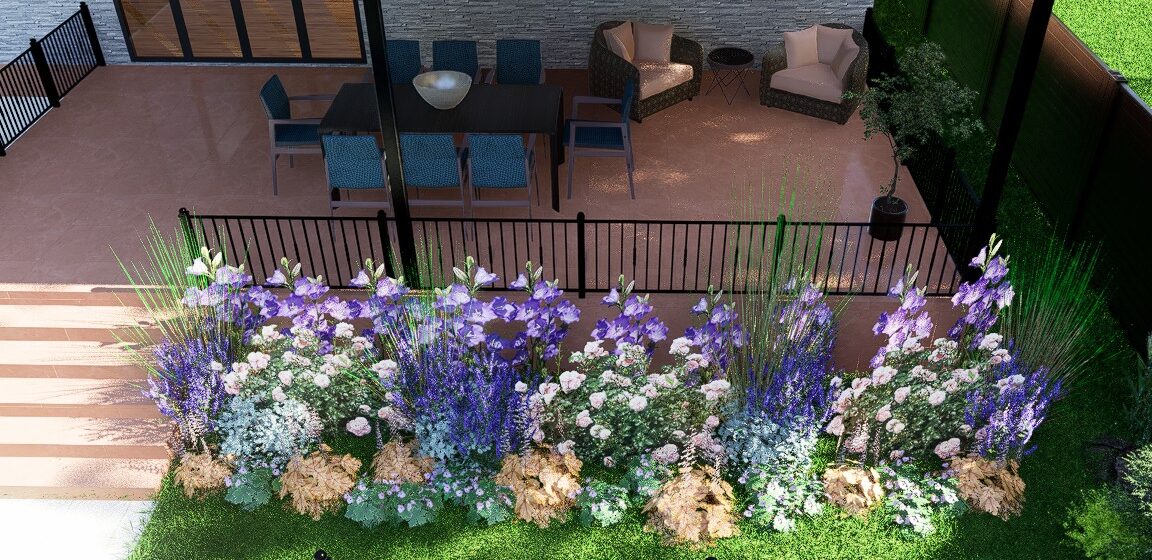
In the meantime, let’s create a flower bed using the trending colors of the year. Pantone’s Color of 2025 is the gentle, warm shade Mocha Mousse. A composition of plants in just one tone may feel flat, even though some people like monochromatic gardens. I suggest a mix of plants in complementary shades that enhance Mocha Mousse with soft, subtle tones. These warm colors bring gentle contrast and harmony with the earthy base color. This palette evokes a spring mood and creates a feeling of comfort and wellbeing.
The flower bed design in powdery-blue tones, suited to seasonal interest from late spring to early fall, works well in sunny or semi-shaded spots. I’ve selected plants of various heights for four visual levels, with diverse textures and bloom times, to create a lively and layered effect.
Volume, leaf texture, blooms in July, panicles decorative through winter
Roses to choose from:
🌿‘Hercules‘ и ‘Larissa‘ (Kordes)
🌿‘Queen of Swedan‘ (David Ostin)
powder pink
Fragrant, constant abundant blooms
🌿Nepeta faassenii ‘Purrsian Blue’
blue
Volume, leaf flavour (use in tea), constant profuse flowering
🌿Carex testacea ‘Prairie fire’
Mousy, reddish-beige
Texture, volume, decorative
🌿Sedum teliphium ‘Matrona‘
powdery
Texture, flowering August-September
Astilbe 'Peach Blossom'
'Hercules' (Kordes)
'Larissa' (Kordes)
'Queen of Swedan' (David Ostin)
Nepeta faassenii 'Purrsian Blue'
Carex testacea 'Prairie fire'
Sedum teliphium 'Matrona'
✨Front: plants 20-40см
Plant
Colour
Function
🌿Artemisia hybrid ‘Powis Castle’
silvery-grey
For contrast and to add a bit of coolness to the warmer shades of the mix
🌿Viola cornuta Horned violet
purple-lilac
Bloomimg in June-August
🌿Lamb’s ears Stachys byzantina
Silvery grey, pale pink inflorescences
Texture and softness of foliage, a contrast to the warm shades of neighbouring plants
🌿Heuchera hybrid ‘Caramel’
Mousy, caramel
Shade of foliage on trend in the right shade, decorative all season long
🌿Geranium pratense ‘Cloud-Nine‘
Pale lilac-blue
Ground cover, blooms June-July
Artemisia 'Powis Castle'
Viola cornuta
Stachys byzantina
Heuchera 'Caramel'
Geranium pratense 'Cloud-Nine'
And now the most important part: You don’t need to plant one of everything from the list – that would look like a hodgepodge. Choose one or two species in every layer and plant 3–5 of each, repeating them throughout the bed to create rhythm and movement. For example, plant 3–5 campanulas or phlox, one or two roses, 3–5 astilbes or perovskias, and in the front – 3–5 heucheras bordered by 8–10 violas. The amount depends on the size of your flower bed.
If you’re unsure whether this powdery color palette will suit your garden, try creating a seasonal mini flower bed in a beautiful pot using, for example, campanula, astilbe, heuchera, and viola. This way, you can decorate a cozy corner of your veranda, and in autumn, plant all of these into the garden.
Leave a comment and share what you’ve created. Feel free to ask any questions—about this topic or anything else related to garden design and plant selection.